
One of the most damaging misconceptions families face is the idea that a child who isn’t talking is simply “lazy” or “defiant.” Parents are often pressured to make their child “earn” items by forcing speech. However, research consistently shows that for minimally verbal or nonverbal children, communication is not a matter of motivation, but of neurological capacity. As the saying goes: “When communication is difficult, pressure does not create speech—support creates connection”.
The 4 Hidden Neurological Barriers to Speech
Behind the silence, a child’s nervous system is often navigating complex hurdles that go beyond behavioral refusal:
1. Motor Control & Apraxia: Conditions like Childhood Apraxia of Speech involve a disruption in the brain’s pathways to the mouth. A child may know the word but cannot coordinate the physical movements to produce the sound.
2. Neurological Processing Delays: Many neurodivergent children experience a “latency delay”. They aren’t ignoring you; their brains require significantly more time to interpret “noise” into meaningful language.
3. Executive Dysfunction: This acts as the brain’s “CEO.” If impaired, a child may have the intention to speak but lack the neurological momentum to initiate the physical process. This explains why they can often sing memorized songs but struggle with spontaneous requests.
4. Sensory Overload: Bright lights or loud noises can drain cognitive energy. When a child is dysregulated, the brain prioritizes survival over the complex task of language.
But They Can Sing the Alphabet! (Asynchronous Development)
It is confusing when a child can recite numbers or sing songs but can’t ask for a glass of water. This is because:
- Memorized vs. Spontaneous: Reciting a familiar script (Echolalia) uses much less brainpower than formulating a brand-new thought in real-time.
- Fluctuating Capacity: A child’s ability to talk isn’t a fixed setting. It fluctuates based on fatigue, stress, and sensory input. Just because they could say a word yesterday doesn’t mean the neurological “pathway” is open today.
The Science of Connection: AAC and Communication Fundamentals
Instead of focusing solely on the physical act of talking, we must build the foundations of communication. Research highlights several key predictors for future language outcomes:
- Receptive Language: Understanding always comes before speaking. Children who develop strong receptive skills are more likely to gain expressive language later.
- Nonverbal Requesting: Longitudinal studies show that early nonverbal requesting (using gestures and eye contact to get help) is a robust predictor of expressive language development in both typical children and those with Down Syndrome.
- Joint Attention: The ability to share attention with a partner—looking at what someone points to—is the “foundation for learning language”.
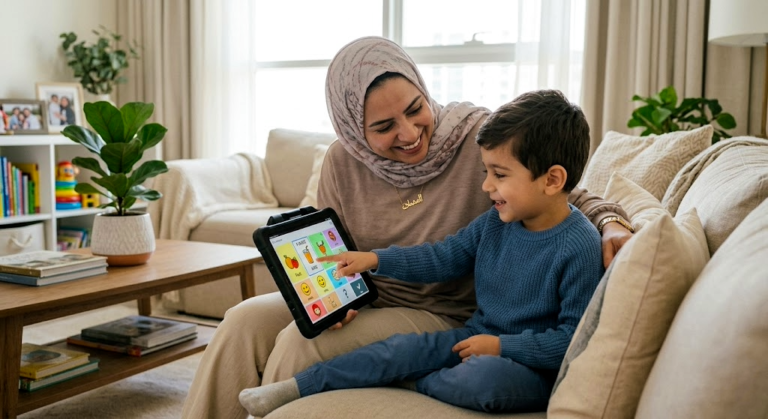
When speech is difficult, Augmentative and Alternative Communication (AAC) tools like iPads or picture boards act as a “reliable backup”. Contrary to the myth that it stops speech, research consistently shows that AAC supports language growth by reducing cognitive load and lowering anxiety.
Actionable Tips for Parents
- Presume Competence: Always assume your child understands more than they can express. “Just because I can’t talk doesn’t mean I can’t think”.
- Model, Don’t Demand: If they point to a cup, give it to them and narrate: “I see you want the cup!” This provides language without the stress of an “earned” task.
- Practice “The Wait”: Give your child 10–20 seconds to process a question. Their brains need this time to formulate a response.
- Focus on Turn-Taking: Build nonverbal “communication circles” through simple back-and-forth games like rolling a ball or high-fives.